
Table of contents
- Start With the Actual Formwork Application
- Core Construction Has a Major Impact on Performance
- Compare Core Options According to Project Requirements
- Film Quality Affects the Concrete Surface and Panel Protection
- Do Not Rely Only on the Term “WBP Glue”
- Thickness Tolerance and Calibration Matter on Site
- Core Gaps and Overlaps Can Become Expensive Problems
- Edge Sealing Is Easy to Overlook but Important
- How Many Times Can Film Faced Plywood Be Reused?
- Storage and Site Handling Can Determine Panel Life
- What Buyers Should Check Before Confirming an Order
- The Cheapest FOB Price Is Not Always the Lowest Formwork Cost
- How Galaxi Wood Approaches Film Faced Plywood Supply
Choosing the right film faced plywood for concrete formwork is not simply about comparing thickness, color and price.
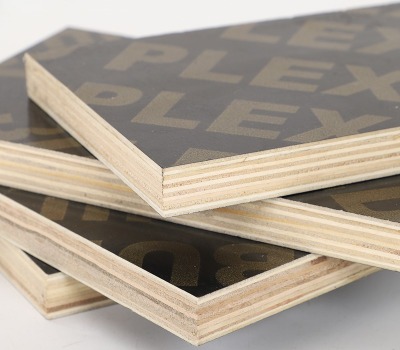
Two sheets may both be described as 18mm black film faced plywood, but their actual performance on a construction site can be very different. Core construction, veneer quality, bonding strength, film quality, thickness tolerance, moisture content, edge sealing and production consistency all affect how the panel performs during concrete pouring and repeated use.
For contractors, importers and building material distributors, the key question is not only how much one sheet costs, but whether the plywood can maintain acceptable surface quality, strength and dimensional stability throughout the intended formwork cycle.
This guide explains the main points buyers should check before ordering film faced plywood for concrete formwork.
Start With the Actual Formwork Application
Before comparing quotations, buyers should first clarify where and how the plywood will be used.
Typical applications include:
- Wall formwork
- Slab formwork
- Column formwork
- Beam formwork
- Foundation work
- Precast concrete production
- General construction formwork systems
A contractor using plywood for one or two simple pours does not necessarily need the same panel construction as a professional formwork company expecting repeated use on a large project.
The required specification may also change according to:
- Concrete pressure
- Span between supports
- Number of expected reuses
- Site handling conditions
- Climate and humidity
- Required concrete surface finish
- Whether panels will be cut repeatedly on site
For this reason, a good film faced plywood specification should begin with the construction application rather than simply asking for the cheapest 18mm board.
Core Construction Has a Major Impact on Performance
The internal core is one of the most important differences between film faced plywood products.
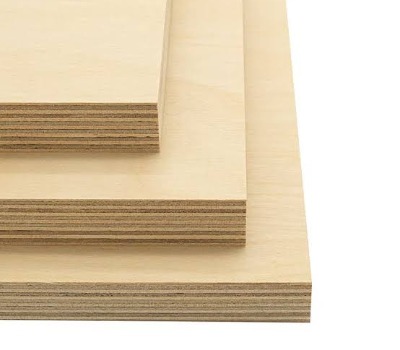
Common options include poplar core, hardwood core, combi core and birch core.
Poplar Core Film Faced Plywood
Poplar core plywood is widely used because it is relatively lightweight, easy to handle and cost competitive.
A well-made poplar core panel can perform effectively in many standard concrete formwork applications.
However, buyers should pay close attention to internal veneer quality. Low-grade poplar panels may contain:
- Large core gaps
- Overlapping veneers
- Uneven veneer thickness
- Poorly repaired defects
- Weak internal veneers
These defects can reduce panel strength and may become more obvious after the plywood absorbs moisture or is repeatedly handled on site.
Hardwood Core Film Faced Plywood
Hardwood core plywood is generally denser and may provide better strength and impact resistance, depending on the wood species and construction.
It is often considered for projects where buyers require stronger panels or more demanding site performance.
However, the term “hardwood core” alone is not a complete specification. Different manufacturers may use different hardwood species, veneer thicknesses and core combinations.
Buyers should therefore confirm the actual construction rather than relying only on the product name.
Combi Core Film Faced Plywood
Combi core plywood combines different veneer species to balance weight, strength and cost.
For many commercial formwork applications, this can provide a practical middle option between lightweight poplar plywood and higher-density constructions.
The most important issue is consistency. If the veneer combination changes significantly between production batches, the panel’s weight, strength and reuse performance may also change.
Birch Core Film Faced Plywood
Birch core plywood is commonly selected for demanding formwork systems where high strength, dimensional stability and edge quality are important.
Its advantages can include:
- Dense and uniform core structure
- High mechanical strength
- Good screw and fixing performance
- Clean cut edges
- Good dimensional stability
The trade-off is usually higher cost and greater panel weight.
For many construction projects, full birch construction may provide more performance than the application actually requires. The correct choice should be based on the required performance level and project economics.
Compare Core Options According to Project Requirements
| Core Type | Typical Weight | Strength | Cost Level | Typical Application |
|---|---|---|---|---|
| Poplar | Light | Medium | Lower | General construction and standard formwork |
| Hardwood | Medium to Heavy | Good | Medium | More demanding construction applications |
| Combi | Medium | Medium to Good | Medium | General formwork requiring balanced cost and performance |
| Birch | Heavy | High | Higher | Professional and high-performance formwork systems |
These descriptions are general guidelines. Actual performance depends on veneer quality, bonding, pressing conditions, moisture control and overall production consistency.
Film Quality Affects the Concrete Surface and Panel Protection
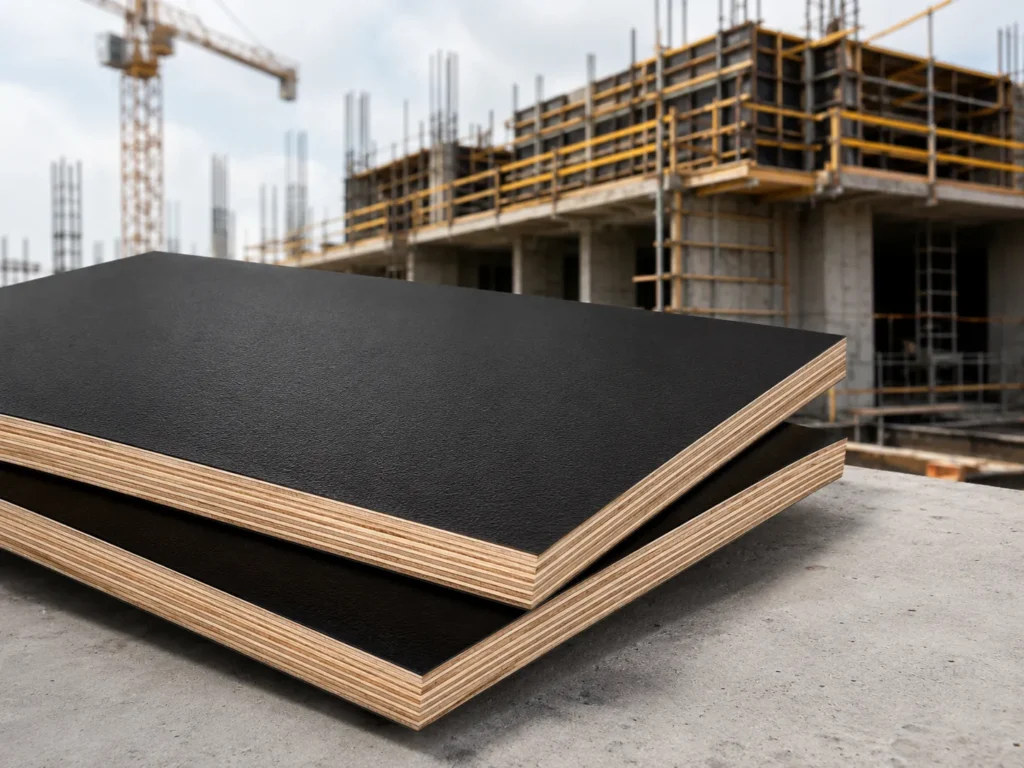
The film layer is not only for appearance. It protects the plywood surface from moisture, concrete and abrasion while also helping produce a smoother concrete finish.
Film faced plywood is commonly supplied with black or brown phenolic film, although other colors and surface options are also available.
The color itself is not a reliable quality indicator.
Buyers should instead pay attention to:
- Film quality
- Film basis weight
- Resin treatment
- Surface bonding
- Abrasion resistance
- Surface smoothness
- Consistency across the sheet
A dark black film does not automatically mean higher performance, just as a lighter brown film does not necessarily mean lower quality.
The quality of the base plywood under the film is equally important. A good film cannot compensate for a weak or unstable core.
Do Not Rely Only on the Term “WBP Glue”
The bonding system is critical because formwork plywood is repeatedly exposed to moisture, wet concrete and changing site conditions.
In international plywood trading, terms such as “WBP glue”, “melamine glue” and “phenolic glue” are commonly used.
However, buyers should be careful with these descriptions.
“WBP” is often used commercially to describe water-resistant bonding performance, but the label alone does not tell the buyer exactly which adhesive system is used or what test performance the panel can achieve.
For professional purchasing, it is better to clarify:
- Actual adhesive type
- Required bonding performance
- Relevant test standard if applicable
- Boiling or water-resistance test requirement
- Target market requirements
Two suppliers may both quote “WBP film faced plywood” while offering panels with significantly different bonding performance.
For repeat container business, the bonding requirement should therefore be written into the agreed technical specification.
Thickness Tolerance and Calibration Matter on Site
Nominal thickness does not mean every sheet will measure exactly the same.
For example, two suppliers may both quote 18mm film faced plywood, but one product may have much tighter thickness control than the other.
Thickness consistency matters because formwork systems often rely on:
- Accurate alignment
- Consistent panel support
- Stable concrete dimensions
- Reliable joints between sheets
- Standardized accessories and framing systems
Buyers should confirm:
- Nominal thickness
- Minimum and maximum acceptable thickness
- Thickness difference across the same sheet
- Sanding or calibration method
- Batch-to-batch consistency
A lower-priced panel with unstable thickness can create additional labor and alignment problems during installation.
Core Gaps and Overlaps Can Become Expensive Problems
One of the biggest differences between low-cost and more stable film faced plywood for concrete formwork is often hidden inside the panel.
The surface may look clean while the internal core contains gaps or overlaps.
These defects can contribute to:
- Weak edges
- Local panel deformation
- Poor screw holding
- Cracking after cutting
- Reduced structural consistency
- Moisture penetration through damaged areas
For serious projects, buyers should inspect more than complete-sheet photographs.
Useful checks include:
- Cut-edge photographs
- Cross-section inspection
- Random panel cutting
- Core gap inspection
- Veneer overlap inspection
For repeat business, these inspection standards can be agreed with the supplier before mass production.
Edge Sealing Is Easy to Overlook but Important
The edges of film faced plywood are more vulnerable to moisture because cutting exposes the internal veneers.
Factories normally apply edge paint or edge sealing to reduce moisture penetration during transport and site use.
Buyers should inspect:
- Whether all four factory edges are sealed
- Whether the coating is continuous
- Whether damaged areas are repaired
- Whether cut edges on site will be resealed
Site handling also matters.
Even a good-quality panel can deteriorate quickly if workers cut it repeatedly and leave exposed edges unprotected in wet conditions.
For projects expecting multiple uses, resealing newly cut edges can help protect the internal veneers and reduce water penetration.
How Many Times Can Film Faced Plywood Be Reused?
This is one of the most common questions from formwork buyers, but it does not have one fixed answer.
Reuse performance depends on many variables, including:
- Core construction
- Bonding quality
- Film quality
- Concrete conditions
- Use of release agent
- How panels are stripped from concrete
- Whether panels are cut
- Edge protection
- Cleaning after each use
- Storage between pours
- Weather conditions
For this reason, buyers should be cautious when a supplier guarantees a very specific number of reuses without knowing the actual site conditions.
A panel may perform very differently on two construction sites even if it comes from the same production batch.
A more useful approach is to define the required panel construction and performance level, then evaluate actual reuse under the buyer’s working conditions.
Storage and Site Handling Can Determine Panel Life
Product quality is only part of the reuse equation.
Improper storage and handling can damage good film faced plywood before the panel reaches the end of its expected service life.
Common site problems include:
- Dragging panels across rough surfaces
- Dropping panels from height
- Using sharp tools carelessly during stripping
- Leaving panels submerged in water
- Storing panels directly on wet ground
- Leaving cut edges unsealed
- Allowing concrete residue to remain on the surface
Good site practice normally includes cleaning panels after stripping, stacking them flat, protecting them from prolonged exposure to water and avoiding unnecessary damage to the film surface.
What Buyers Should Check Before Confirming an Order
Before placing a container order, buyers should define the main specification clearly.
| Item | What to Confirm |
|---|---|
| Application | Wall, slab, column, beam, precast or general formwork |
| Panel Size | Length × width |
| Thickness | Nominal thickness and acceptable tolerance |
| Core | Poplar, hardwood, combi, birch or customized construction |
| Film | Color, type and required surface performance |
| Bonding | Adhesive system and required water-resistance performance |
| Density | Target range if relevant to the project |
| Moisture | Agreed moisture requirement |
| Core Quality | Limits for gaps, overlaps and internal defects |
| Edge Sealing | Factory edge protection requirements |
| Packing | Pallet construction, straps and moisture protection |
| Inspection | Pre-shipment inspection and random cutting requirements |
| Loading | Sheets per package, packages per container and weight limit |
For regular purchasing, these requirements should ideally be converted into a fixed technical specification.
This reduces misunderstandings and makes it easier to compare different suppliers on the same basis.
The Cheapest FOB Price Is Not Always the Lowest Formwork Cost
Film faced plywood is often compared by price per sheet or price per cubic meter.
That is necessary, but it does not show the complete cost.
Consider two plywood options:
- Option A has a lower FOB price but develops edge damage, delamination or excessive deformation after limited use.
- Option B costs more per sheet but remains usable for longer under the same site conditions.
The cheaper quotation may not produce the lower project cost.
For professional buyers, a more useful calculation is:
Total plywood cost ÷ actual number of usable formwork cycles.
Buyers should also consider indirect costs such as:
- Replacement panels
- Additional site labor
- Poor concrete surface finish
- Repair work
- Construction delays
- Material waste
This is why stable quality between shipments is particularly important for contractors and distributors handling repeat projects.
How Galaxi Wood Approaches Film Faced Plywood Supply
Galaxi Wood works with established plywood production resources in Linyi, China, supplying film faced plywood for concrete formwork, construction and building material distribution.
Depending on the project, specifications can be developed around:
- Poplar, hardwood, combi and other core options
- Black or brown film surfaces
- Different panel sizes and thicknesses
- Bonding and moisture-resistance requirements
- Thickness tolerance
- Core quality requirements
- Edge sealing
- Export packing
- Container loading requirements
For buyers sourcing film faced plywood for concrete formwork, the most useful starting point is to share the actual application, required size and thickness, expected performance level and approximate order quantity.
From there, the plywood construction can be matched to the project requirements and target cost instead of selecting a panel based only on the lowest price.
Explore our film faced plywood products or view our wider plywood supply options for more information.